整合 GLCM 影像特徵與紋影技術之量化水污染分析系統
Quantitative Water Pollution Analysis System Integrating GLCM Image Features with Schlieren Imaging Technology
Section titled “Quantitative Water Pollution Analysis System Integrating GLCM Image Features with Schlieren Imaging Technology”Jia-Ming Zhou, Wen-Lin Chu, and Bo-Lin Jian
摘要 Abstract
Section titled “摘要 Abstract”本研究提出一套整合 Z 型紋影光學與近紅外線光譜的水質分析系統,用於量測水中塑膠熱劣化過程所產生的微粒與濁度變化。 系統以精密紋影成像觀察水體密度微小變化,並配合近紅外線光譜進行粒徑與成分輔助判讀。 研究建立基於灰階共生矩陣(GLCM)的紋理特徵萃取流程, 從不同距離與方向計算對比度、相關性、能量與同質性等指標,作為濁度預測模型輸入。 以 PP 塑膠在 60–100°C、60 分鐘熱裂解實驗為案例,並同步以標準濁度計建立影像特徵與實測濁度對應資料庫, 初步結果顯示,不同溫度與降解條件下的微粒結構具可分辨的紋理差異,證實該方法可望用於精準水污染與微塑膠風險偵測之量化分析基礎。
This work presents an integrated water pollution analysis system that combines a Z-type schlieren optical setup with near-infrared spectroscopy to monitor microparticles generated during the thermal degradation of plastic materials in water. The proposed framework exploits the high sensitivity of schlieren imaging to visualize subtle density variations and employs near-infrared spectral measurements to assist particle size and concentration assessment. A feature extraction pipeline based on Gray Level Co-occurrence Matrix (GLCM) is developed, where contrast, correlation, energy, and homogeneity calculated over multiple distances and directions serve as inputs to a turbidity prediction model. Experiments on PP plastics thermally degraded between 60–100°C for 60 minutes, with synchronized measurements from a standard turbidimeter, establish a correspondence database between image-derived features and turbidity values. Preliminary results indicate that microparticle structures formed under different degradation conditions exhibit clearly distinguishable texture signatures, demonstrating the feasibility of the proposed approach as a quantitative, high-precision tool for microplastic-related water pollution monitoring and future turbidity prediction model development. The study incorporates flow velocity sensors for cross-validation to ensure analytical reliability. This innovative methodology not only reveals the blocking effects of masks on airflow propagation pathways and velocities but also provides objective scientific data to support public health epidemic prevention strategies, demonstrating significant practical application value.
關鍵字 Keywords
Section titled “關鍵字 Keywords”- 彩色紋影技術 Color Schlieren Techniques
- 微塑膠污染 Microplastic pollution
- 灰階共生矩陣 Gray Level Co-occurrence Matrix (GLCM)
- 濁度預測 Turbidity prediction
- 塑膠熱降解 Plastic thermal degradation
研究結果示例
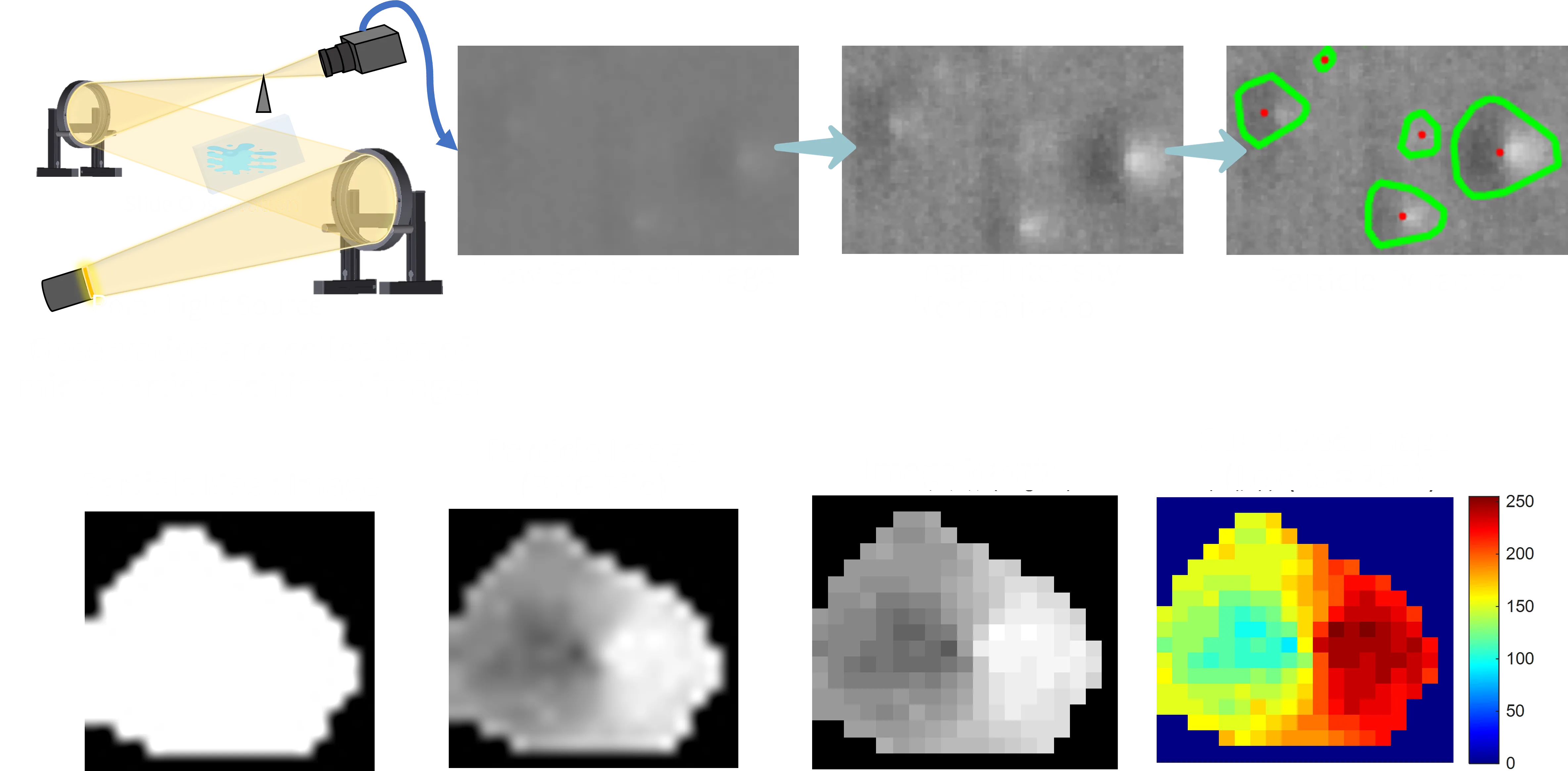
Section titled “研究結果示例”圖示上排左側呈現雙光源配置的 Schlieren 光學架構,透過精密透鏡組與 CMOS 相機捕捉水中微粒子造成的折射率梯度變化,此設計對微米級塑膠熱降解產物具有極高靈敏度。
影像處理流程從原始低對比度 Schlieren 影像(上排中央灰色區塊)開始,經對比度增強與雜訊抑制後生成增強型影像(右側第二張),使微粒子密度擾動以明亮局部特徵呈現。右側影像展示自動化目標偵測結果,綠色輪廓標註微粒子邊界,紅點標記質心位置,實現即時計數與尺寸統計。下排四張影像呈現 GLCM 紋理特徵提取的多階段轉換過程。左側二值化遮罩分離前景與背景,灰階強度場保留原始光強度資訊供後續統計計算,第三張影像量化特定方向的紋理統計量(如對比度或能量空間分布),最右側熱圖整合多方向(0°, 45°, 90°, 135°)與多距離參數的 GLCM 特徵,色階 0–250 編碼數值範圍,紅色高值區域對應微粒子密集或紋理複雜度峰值區塊。
實驗設計以 PP 塑膠在 60–100°C 熱降解 60 分鐘為條件,同步記錄標準濁度計讀值與 Schlieren 影像資料。不同降解條件產生的微粒子結構在 GLCM 四維特徵空間(對比度、相關性、能量、均勻性)中展現可區分的紋理,初步驗證了透過光學特徵預測濁度值的可行性,為非接觸式微塑膠污染定量監測提供高精度工具原型。
引用格式 BibTeX
Section titled “引用格式 BibTeX”@inproceedings{zhou2025automation, author = {Jia-Ming Zhou and Wen-Lin Chu and Bo-Lin Jian}, title = {Quantitative Water Pollution Analysis System Integrating GLCM Image Features with Schlieren Imaging Technology}, booktitle = {The 22nd International Conference on Automation Technology (Automation 2025)}, year = {2025}, month = {November}, address = {Kaohsiung, Taiwan} url = {https://automation2025.nsysu.edu.tw}}