針對荷蘭牛非妊娠期及分娩後階段體重預測的應用
Application of weight prediction for Holstein dairy cows in non-pregnant and postpartum stages
Section titled “Application of weight prediction for Holstein dairy cows in non-pregnant and postpartum stages”摘要 Abstract
Section titled “摘要 Abstract”本研究基於深度感測技術開發一套針對荷蘭乳牛(Holstein dairy cow)的非接觸式體重預測系統,用以預測乳牛在非妊娠期與產後階段的體重變化。系統使用 Intel RealSense D455 深度攝影機 擷取乳牛背部、髖部與側面區域的深度影像資訊,並透過系統化的資料處理流程萃取有效的體表特徵資料。實驗結果顯示,高斯過程回歸模型(Gaussian Process Regression,GPR)在乳牛背部區域的表現最佳。例如,於非妊娠期的乳牛編號 cid603,其預測精度達均方根誤差 (RMSE) 19.37 kg 與平均絕對百分比誤差 (MAPE) 1.82 %;在產後階段的乳牛編號 cid700,模型維持 RMSE = 22.35 kg 與 MAPE = 2.74 %,展現出良好的模型泛化能力。與傳統以體長與胸圍測量為基礎的牧場估重方法相比,本研究所提出的體重預測系統在準確度與穩定性上均有顯著提升,特別能有效捕捉生理狀態變化(如產後體重下降)。實驗結果顯示,使用背部區域特徵資料的 GPR 模型具最佳預測與泛化能力,能有效支援乳牛體重的精準監測。未來研究方向應著重於優化影像前處理技術、結合更多生理參數(如飼料攝取量),並融合多角度深度資訊,以提升系統於複雜環境下的適應性,進而強化體重預測模型的普適性與可靠性。
A non-contact weight prediction system for Holstein dairy cows was developed based on depth sensing technology, designed to predict weight changes during non-pregnant and postpartum stages. The system utilises an Intel RealSense D455 depth camera to capture depth image information from cow’s dorsal, hips, and side regions, extracting effective body surface feature data through a systematic data processing workflow. Experimental results demonstrate that the Gaussian Process Regression (GPR) model performed most excellently in the cow’s dorsal region. For example, with cow number cid603 during the non-pregnant period, prediction accuracy reached a root mean square error (RMSE) of 19.37 kg and a mean absolute percentage error (MAPE) of 1.82 %; with cow number cid700 in the postpartum stage, the model maintained an RMSE of 22.35 kg and MAPE of 2.74%, exhibiting robust model generalisation capability. Compared to traditional farm methods based on body length and heart girth measurements, the weight prediction system proposed in this study significantly improved the accuracy and stability of weight prediction, especially in capturing physiological state changes (such as postpartum weight loss). Experimental results indicate that the GPR model exhibited the best predictive ability and generalisation with feature data from the dorsal region, effectively supporting precise monitoring of dairy cow weight. Future research directions should focus on optimising image preprocessing techniques, incorporating more physiological parameters (such as feed intake), and integrating depth information from different angles to enhance the system’s adaptability in complex environments, thereby strengthening the universality and reliability of the weight prediction model.
關鍵字 Keywords
Section titled “關鍵字 Keywords”- 產後階段 Postpartum stages
- 體重預測 Body weight prediction
- 健康監測 Health monitoring
- 機器學習 Machine learning
亮點 Highlights
Section titled “亮點 Highlights”- 與傳統方法相比,深度影像技術能精確預測荷斯坦乳牛體重。
- 透過深度影像擷取之體表特徵可用於體重預測模型的建構。
- 高斯過程回歸 (Gaussian Process Regression,GPR) 使用背部區域資料時達到最佳準確度。
- GPR 模型具有高精度:非妊娠期 MAPE = 1.82 %,產後期 MAPE = 2.74 %。
- 系統可監測乳牛於不同生理狀態(如產後)期間的體重變化。
- Depth imaging accurately predicts Holstein cattle weight vs traditional methods.
- Body surface features from depth imagery enable weight prediction modelling.
- Gaussian Process Regression achieves optimal accuracy using dorsal region data.
- GPR model shows high accuracy: non-pregnant (MAPE 1.82 %) & postpartum (MAPE 2.74 %).
- System monitors weight changes during physiological states like postpartum.
研究結果示例
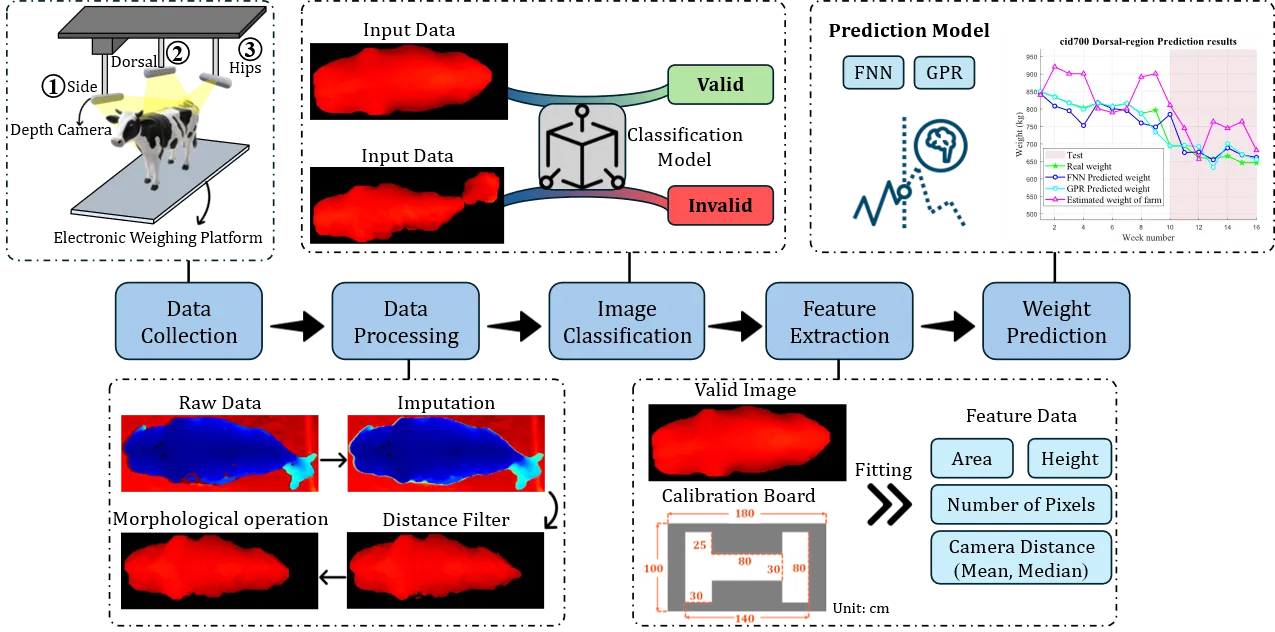
Section titled “研究結果示例”為了開發一套穩健的非接觸式影像體重預測系統,本研究以下圖所示之實驗流程為核心架構,系統性地進行實驗設計與資料分析。本研究使用深度攝影機蒐集實驗乳牛之側面、背部與臀部的影像資料,並針對各部位之深度資訊進行處理。資料處理流程包括乳牛辨識、缺值補插 (Missing value imputation)、距離濾波 (Distance filtering)、形態學運算 (morphological operations) 與連通元件分析 (connected component analysis),以獲得更完整的乳牛體表深度資訊並有效濾除多餘的深度雜訊。隨後,透過影像分類器篩選各部位之有效且高品質影像,並利用校正板面積建立各部位的面積擬合模型。其他特徵資料包含乳牛身高、各部位像素數量,以及乳牛各部位與攝影機之間的距離(取平均值與中位數)。最後,本研究採用前饋式神經網路 (Feedforward Neural Network,FNN) 與高斯過程回歸模型 (Gaussian Process Regression,GPR) 進行體重預測,並對預測結果進行評估。
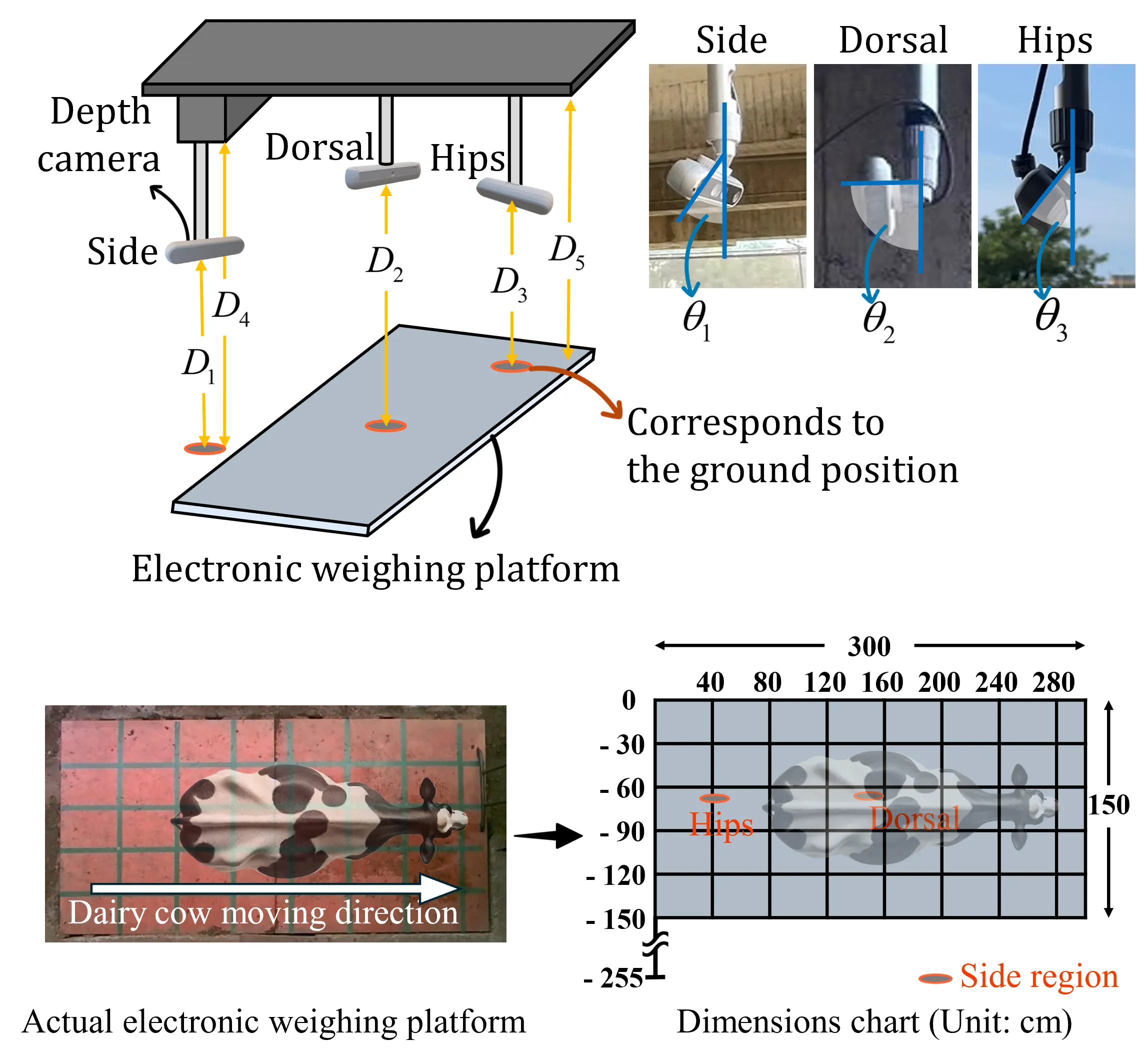
為確保能有效擷取乳牛影像,本研究調整了各攝影機位置的地面距離 (D) 與角度 (θ)。側面、背部與髖部攝影機的地面距離分別為 D₁ = 212 cm、D₂ = 195.7 cm、D₃ = 276.8 cm;拍攝角度分別為 θ₁ = 50°、θ₂ = 90°、θ₃ = 40°。此外,位於牛舍屋簷下橫樑與屋簷本身的地面距離分別為 D₄ = 327 cm 與 D₅ = 382 cm。透過上述硬體配置,本研究將電子秤台尺寸劃分為座標點,作為去除深度影像背景以及估算乳牛各部位面積特徵的量化依據。
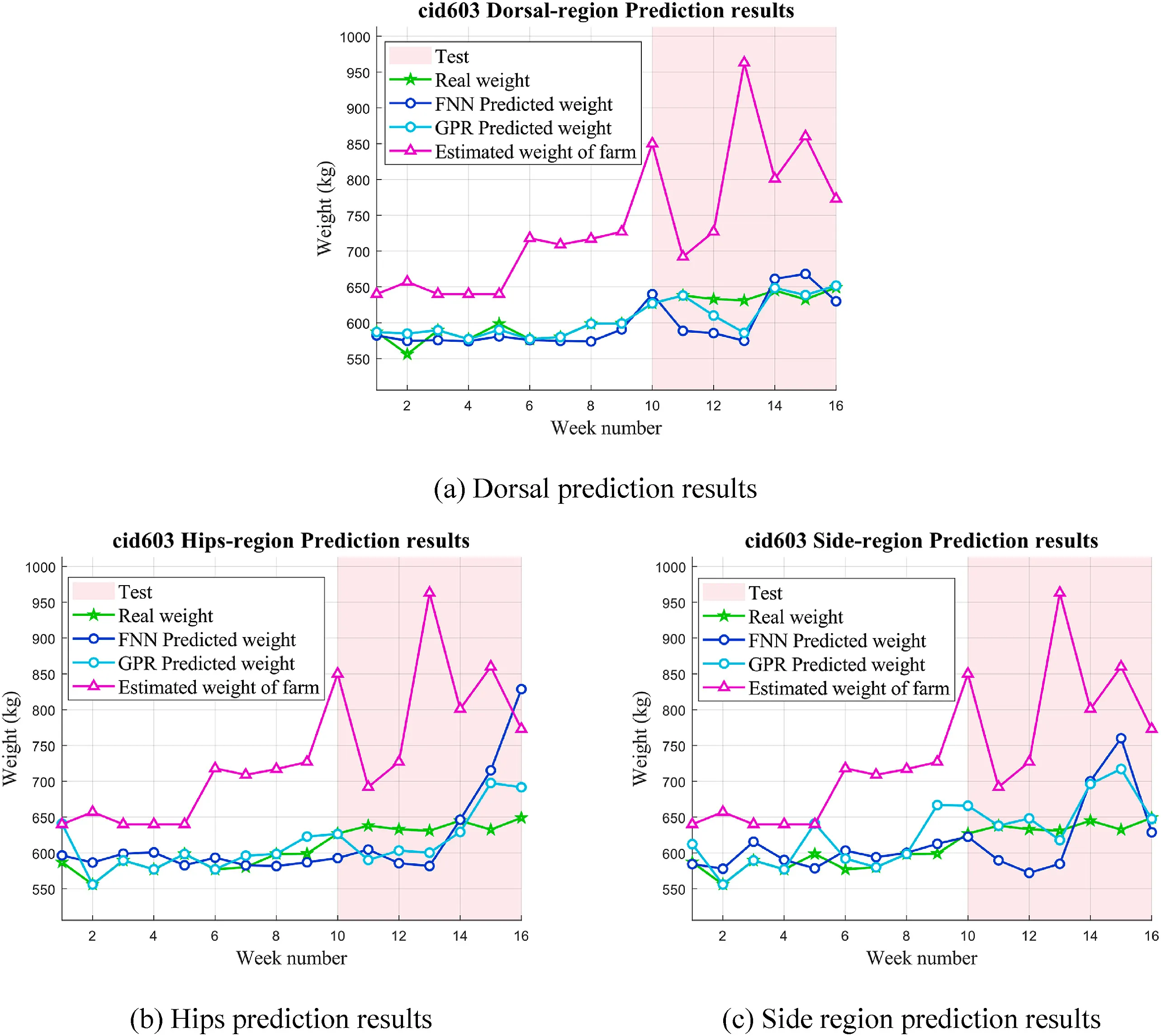
下圖比較了乳牛編號 cid603 在背部、臀部及側面三個區域的每週實際體重(綠色曲線,取自電子秤台測量值)、FNN 模型預測結果(藍色曲線)、GPR 模型預測結果(青色曲線),以及牧場估重值(洋紅色曲線,根據體長與胸圍量測推估)。在訓練階段(第 1 至第 9 週),FNN 與 GPR 模型的預測結果皆與實際體重曲線相近,顯示兩者具良好的訓練擬合能力;而測試階段(第 10 至第 16 週,以淡紫色背景標示)則用於評估模型的泛化能力。
結果顯示,在測試階段中,FNN 與 GPR 模型於背部區域的預測誤差最小,其預測穩定性亦優於臀部與側面區域。特別值得注意的是,GPR 模型在背部區域的預測結果與實際體重變化趨勢最為接近。雖然 GPR 模型在整體訓練資料上的表現略遜於 FNN 模型,但在非妊娠乳牛的測試資料集上卻展現出更佳的泛化能力。相對地,牧場以體長與胸圍推估的體重在三個區域中皆與實測值有明顯偏差,特別是在測試階段,其曲線波動大、誤差高,凸顯傳統體尺估重方法在準確性上的限制。
引用格式 BibTeX
Section titled “引用格式 BibTeX”@article{CHIANG2025104276,title = {Application of weight prediction for Holstein dairy cows in non-pregnant and postpartum stages},journal = {Biosystems Engineering},volume = {259},pages = {104276},year = {2025},issn = {1537-5110},doi = {https://doi.org/10.1016/j.biosystemseng.2025.104276},url = {https://www.sciencedirect.com/science/article/pii/S1537511025002120},author = {Hsin-I Chiang and Jia-Ming Zhou and Wen-Lin Chu},keywords = {Postpartum stages, Body weight prediction, Health monitoring, Machine learning},abstract = {A non-contact weight prediction system for Holstein dairy cows was developed based on depth sensing technology, designed to predict weight changes during non-pregnant and postpartum stages. The system utilises an Intel RealSense D455 depth camera to capture depth image information from cow's dorsal, hips, and side regions, extracting effective body surface feature data through a systematic data processing workflow. Experimental results demonstrate that the Gaussian Process Regression (GPR) model performed most excellently in the cow's dorsal region. For example, with cow number cid603 during the non-pregnant period, prediction accuracy reached a root mean square error (RMSE) of 19.37 kg and a mean absolute percentage error (MAPE) of 1.82 %; with cow number cid700 in the postpartum stage, the model maintained an RMSE of 22.35 kg and MAPE of 2.74 %, exhibiting robust model generalisation capability. Compared to traditional farm methods based on body length and heart girth measurements, the weight prediction system proposed in this study significantly improved the accuracy and stability of weight prediction, especially in capturing physiological state changes (such as postpartum weight loss). Experimental results indicate that the GPR model exhibited the best predictive ability and generalisation with feature data from the dorsal region, effectively supporting precise monitoring of dairy cow weight. Future research directions should focus on optimising image preprocessing techniques, incorporating more physiological parameters (such as feed intake), and integrating depth information from different angles to enhance the system's adaptability in complex environments, thereby strengthening the universality and reliability of the weight prediction model.}}